
In the global wire and cable industry, the performance of a PVC (Polyvinyl Chloride) compound is fundamentally anchored by its stabilization system. During high-speed extrusion, PVC is inherently susceptible to thermal degradation, where the polymer releases hydrochloric acid (HCl). Without a high-performance pvc stabilizer for cable, this autocatalytic reaction leads to brittle insulation, “greening” of the copper conductor, and a total loss of dielectric properties.
For engineers and procurement managers, selecting a stabilizer is a multi-dimensional decision. It involves balancing immediate processing requirements—such as heat stability and lubrication—with long-term field performance, including UV resistance and electrical insulation. As global environmental mandates tighten, the transition from traditional lead-based systems to advanced Calcium-Zinc (Ca-Zn) “one-pack” stabilizers has become the standard for modern manufacturing.
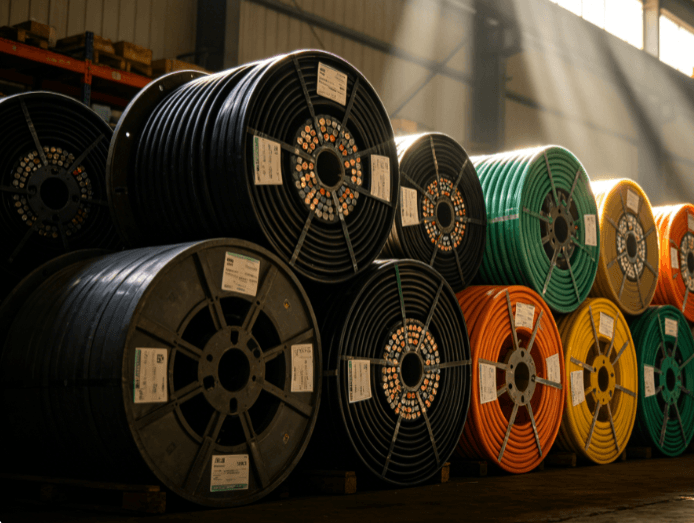
Critical Performance Metrics for Cable Stabilizers
Selecting a stabilizer for cable applications differs significantly from selecting one for rigid PVC pipes or profiles. The presence of plasticizers and the requirement for high electrical volume resistivity (VR) create unique chemical constraints.
When evaluating a pvc stabilizer for cable, three technical benchmarks are non-negotiable:
- Static and Dynamic Heat Stability: The stabilizer must neutralize HCl throughout the extrusion residence time and protect the polymer during potential line stoppages.
- Electrical Volume Resistivity (VR): The stabilizer must not introduce conductive ions that lower the insulation resistance of the compound, particularly in high-voltage or wet-environment applications.
- Congo Red Stability Time: This is the industry-standard measure of how long a stabilized compound can withstand 200°C before failing. For high-grade automotive or building wire, a high Congo Red value is essential.
In large-volume production, even a slight imbalance in the stabilizer formulation can lead to “plate-out”—the accumulation of additives on the die lip—resulting in surface defects that force costly production shutdowns.
Technical Comparison: Ca-Zn vs. Lead-Based Systems
The transition to lead-free stabilizers is no longer a matter of preference but a regulatory requirement under RoHS and REACH. However, the chemical transition requires a nuanced understanding of processing behavior.
Calcium-Zinc (Ca-Zn) One-Pack Stabilizers
Modern Ca-Zn stabilizers are complex “one-pack” systems that integrate acid scavengers, co-stabilizers (like polyols or hydrotalcites), and antioxidants.
Considerations: Generally have a narrower processing window than lead; require a sophisticated lubrication balance to prevent scorching.
Advantages: Non-toxic, environmentally compliant, and excellent initial color hold for color-coded wires.
Lead-Based Stabilizers (Legacy)
Traditionally, Tri-basic Lead Sulfate (TBLS) and Di-basic Lead Stearate (DBLS) were the workhorses of the industry.
- Advantages: Exceptional thermal stability, very wide processing latitude, and naturally superior electrical insulation.
- Considerations: High toxicity, environmental restrictions, and the requirement for stringent dust-control measures in the factory.
| Feature | Ca-Zn One-Pack | Lead-Based (One-Pack) |
| Environmental Compliance | RoHS / REACH Compliant | Restricted / Phase-out |
| Volume Resistivity | Good to Excellent | Superior |
| Surface Finish | High Gloss / Smooth | Matte to Semi-Gloss |
| Moisture Sensitivity | Moderate | Low |
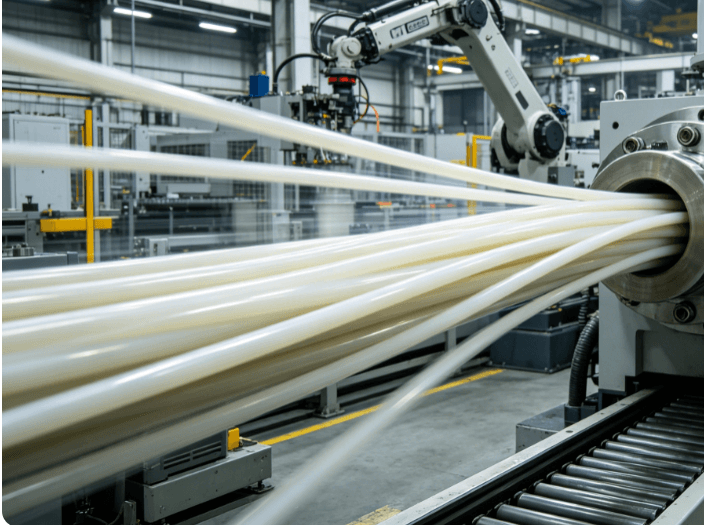
Optimizing Extrusion OEE through Lubrication Balance
A specialized pvc stabilizer for cable serves a secondary, vital role as a processing aid. The lubrication system within the “one-pack” manages the friction between the PVC melt and the extruder barrel/screw.
- Internal Lubricants: Reduce the molecular friction of the PVC chains, lowering the melt temperature and preventing thermal “hot spots.”
- External Lubricants: Prevent the hot melt from sticking to the metal surfaces of the die and screw, ensuring a smooth, defect-free cable surface.
For high-speed extrusion lines (running at 600–1200 meters per minute), the lubrication balance is critical. Too much lubricant leads to poor fusion and mechanical weakness; too little leads to “scorching” and surface roughness. MKQ Chem’s PVC Stabilizer solutions are engineered to provide this delicate balance, ensuring high Overall Equipment Effectiveness (OEE) and minimal scrap rates.
Compliance and Quality Assurance in B2B Procurement
From a manufacturing consultant’s perspective, the “cheapest” stabilizer often results in the highest total cost of production. When sourcing a pvc stabilizer for cable, procurement teams must verify the supplier’s commitment to consistency.
Essential Evaluation Criteria:
- Batch-to-Batch Uniformity: Variation in the metallic soap content can cause unpredictable shifts in melt viscosity, leading to diameter fluctuations in the finished cable.
- Heavy Metal Limits: For RoHS-compliant lines, the stabilizer must be certified to contain less than 1000ppm of lead, mercury, or cadmium.
- Compatibility with Fillers: Most cable compounds use high loadings of Calcium Carbonate or Flame Retardants (like ATH). The stabilizer must be robust enough to coat these particles and prevent them from degrading the polymer matrix.
Strategic Selection: Matching Stabilizer to Application
The “one-size-fits-all” approach does not work in the cabling sector. Each application requires a specific stabilization chemistry:
- 70°C General Purpose Wire: Focuses on cost-efficiency and basic thermal stability for building and household applications.
- 105°C Heat-Resistant Automotive Wire: Requires advanced antioxidant packages and high-performance Ca-Zn systems to survive long-term aging tests (e.g., ISO 6722).
- UL-Rated Flame Retardant Cables: Must maintain stability in the presence of high concentrations of Antimony Trioxide or other FR additives without compromising electrical integrity.
At MKQ Chem, our product-category range covers these diverse needs, offering both high-efficiency lead-free one-packs and specialized systems for high-temperature applications. We understand that in a B2B environment, technical support—such as lab-scale compounding and aging tests—is as valuable as the chemical itself.
FAQ: Professional Procurement & Technical Questions
Q1: How does the stabilizer affect the “stripping” property of the cable?
The stripping property (how easily the insulation is removed from the conductor) is heavily influenced by the external lubricant content in the stabilizer package. If the lubrication is too high, the insulation may feel “oily” and slip; if it’s too low, the PVC may bond too tightly to the copper, making manual stripping difficult for electricians.
Q2: What is the typical dosage of a “one-pack” PVC stabilizer for cable?
Dosage typically ranges from 2.5 to 5.0 parts per hundred resin (phr), depending on the thermal rating and filler loading. Higher temperature ratings (105°C) or highly filled compounds generally require a higher stabilizer dosage to maintain the induction period.
Q3: Can Ca-Zn stabilizers match the electrical performance of lead?
Yes. Modern high-purity Ca-Zn systems utilize hydrotalcite and specialized polyols to capture HCl without forming conductive salts. When formulated correctly, these systems meet the stringent volume resistivity requirements for most low-to-medium voltage applications.
Q4: How do I prevent “plate-out” on my high-speed extrusion line?
Plate-out is often caused by an over-lubrication or the use of incompatible pigments. Switching to a stabilizer with a more refined lubricant balance and ensuring that the internal-to-external lubricant ratio is tuned for your specific extruder L/D ratio can eliminate this issue.
Q5: What certifications should I request from a PVC stabilizer manufacturer?
For the cable industry, you should request RoHS 3.0 compliance reports, REACH SVHC declarations, and technical data sheets (TDS) showing the Congo Red stability time and electrical volume resistivity.