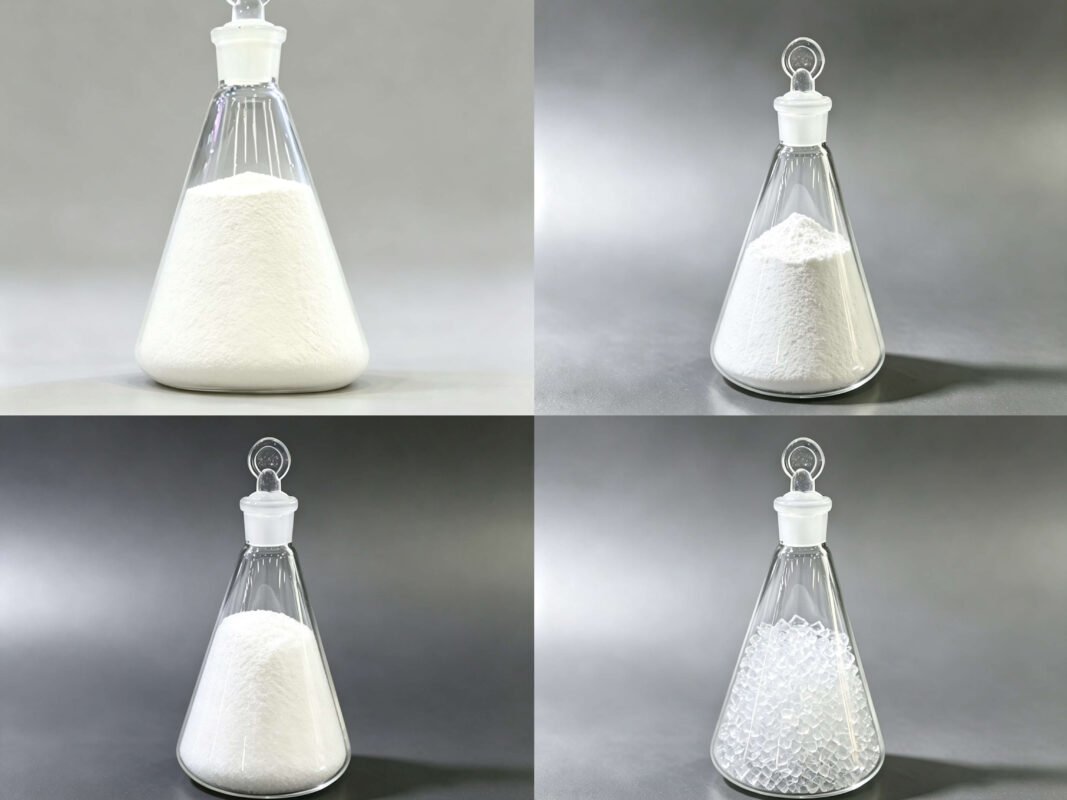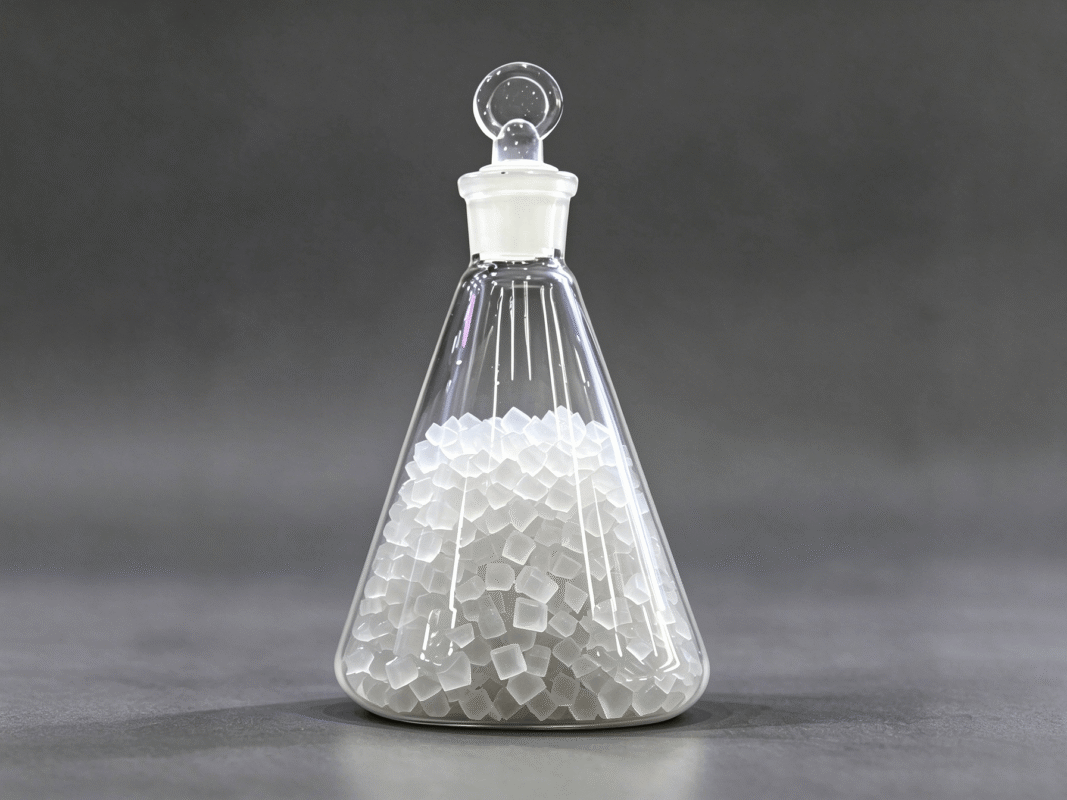

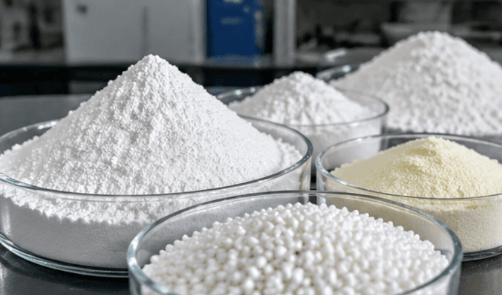
PVC foam board density control depends on the balance between gas generation, melt strength, cell stability, filler loading, and extrusion conditions. Foaming agents create gas inside the PVC melt, while processing aids and foaming regulators help the material retain expanding cells. Stabilizers and lubricants support consistent processing, but their effects must be considered as part of the complete formulation. A stable density cannot be achieved by adjusting foaming agent dosage alone.
For PVC foam board manufacturers, the objective is to achieve the specified density while maintaining uniform cell structure, sufficient mechanical strength, consistent thickness, and acceptable surface quality. Understanding how each additive influences expansion helps manufacturers reduce density fluctuations and improve production repeatability.
What Is PVC Foam Board Density?
PVC foam board density is the mass of the finished board divided by its external volume. It is commonly expressed in kg/m³ or g/cm³. Because foam boards contain gas-filled cells, their apparent density is lower than that of the solid PVC compound from which they are produced.
Density is influenced by both material composition and expansion behavior. A board with more effective expansion generally contains a larger gas-cell volume relative to its solid material content. However, excessive expansion can weaken the structure if the melt cannot retain stable cells.
Manufacturers should therefore evaluate density together with board thickness, cell distribution, surface appearance, and mechanical properties.
How PVC Additives Affect Final Foam Board Density
1. Chemical Foaming Agents: Controlling Gas Generation
Foaming agents are the primary additives responsible for generating gas during PVC foam extrusion. The released gas forms bubbles within the softened PVC compound, allowing the material to expand and develop a cellular structure.
Different foaming agents have different decomposition temperatures, gas yields, and release characteristics. These properties influence how much gas is available and whether gas generation matches the processing conditions.
Insufficient effective gas generation may result in limited expansion and higher finished-board density. Excessive or poorly timed gas release can cause cell coalescence, surface defects, or unstable dimensions.
Manufacturers should evaluate:
- Foaming agent chemistry and grade.
- Gas yield under the supplier’s specified test conditions.
- Decomposition temperature and processing compatibility.
- Particle size and dispersion in the PVC compound.
- Compatibility with the stabilizer and processing aid systems.
For grade comparison, manufacturers can review the PVC foaming agent product category and confirm application-specific specifications before selecting a formulation.
2. Processing Aids: Maintaining Melt Strength and Cell Stability
Processing aids influence PVC fusion, melt elasticity, and the ability of the compound to retain expanding gas bubbles. Their contribution is particularly important when producing lightweight foam boards or products with demanding cell-structure requirements.
If melt strength is insufficient, expanding cells may merge or collapse before the board stabilizes. This can produce uneven density, large internal voids, and inconsistent mechanical properties.
A suitable high-molecular-weight processing aid or foaming regulator can help the melt maintain a more stable cellular structure. However, excessive addition may increase viscosity, torque, or extrusion pressure.
Processing aids do not generate gas. Their role is to support the melt during expansion, which is different from the function of a chemical foaming agent.
For more details, see the PVC processing aid for foam board guide.
3. Calcium Carbonate: Influencing Compound Mass and Rheology
Calcium carbonate is commonly used in PVC foam board formulations to adjust stiffness, material cost, and processing characteristics. However, changing filler content affects both the mass of the compound and its rheological behavior during expansion.
Increasing calcium carbonate content does not automatically produce a predictable increase or decrease in final density. The result depends on how filler loading changes the compound’s expansion behavior, melt strength, dispersion, and cell structure.
Manufacturers should evaluate filler content together with the foaming agent and processing aid system. A formulation that produces acceptable density at one filler loading may require revalidation after a significant change in calcium carbonate content.
4. Heat Stabilizers: Protecting PVC During Processing
Heat stabilizers help delay PVC thermal degradation during extrusion. If the compound experiences excessive thermal exposure, degradation may cause discoloration, changes in processing behavior, and contamination from degraded material.
Although stabilizers do not directly generate foam or determine expansion, stable thermal processing helps maintain consistent material behavior during production.
Manufacturers should select a stabilizer compatible with the PVC resin, processing temperature, and complete additive package. The stabilizer system should be evaluated together with residence time and lubrication rather than treated as an independent density-control additive.
5. Lubricants: Influencing Fusion and Material Flow
Internal and external lubricants influence friction, fusion timing, melt flow, and release from metal surfaces. Their balance can affect the conditions under which the PVC compound expands and retains gas.
Excessive external lubrication may delay fusion, while insufficient lubrication can increase friction or cause material sticking under certain processing conditions.
When density becomes unstable after a formulation change, manufacturers should review the lubrication system alongside the foaming agent and processing aid. Increasing one additive without checking the others may create new processing problems.
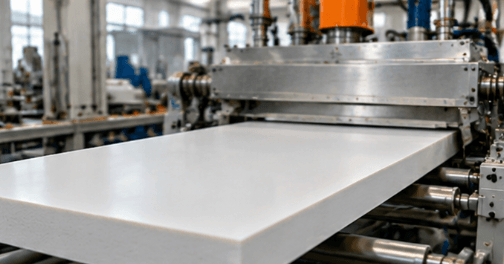
Other Factors That Affect PVC Foam Board Density
1. PVC Resin Characteristics
PVC resin characteristics influence fusion, melt viscosity, and the ability of the compound to retain gas during expansion. A change in resin grade or supplier may alter processing behavior even when the additive dosage remains unchanged.
When changing resin, manufacturers should compare the resulting density, cell structure, and extrusion stability before approving the formulation for regular production.
2. Extrusion Temperature and Residence Time
Temperature determines how the compound develops during extrusion and influences the decomposition behavior of the foaming agent. If gas is released too early, it may escape before the melt can retain it. If decomposition is incomplete or poorly timed, expansion may be insufficient.
Residence time also matters. Material exposed to heat for too long may undergo degradation, while inconsistent material flow can produce differences in expansion across production runs.
Record temperature settings, actual melt temperature where available, screw speed, output, and production interruptions when investigating density variation.
3. Screw Configuration and Extrusion Stability
Screw design affects mixing, shear, material transport, and residence time. Differences in screw configuration and operating conditions can change how uniformly the additives disperse and how the compound develops before entering the die.
Unstable feeding, excessive shear, or inconsistent output may contribute to variations in foam structure and finished-board density.
4. Die Design, Calibration, and Cooling
The die controls the shape and distribution of the extruded material, while calibration and cooling influence the final dimensions and structure.
Uneven cooling can cause warping, thickness variation, or dimensional instability. Calibration problems may also affect the relationship between expansion and finished-board dimensions.
Density problems should therefore be evaluated across the entire extrusion and downstream process, not only at the additive mixing stage.
How to Control PVC Foam Board Density in Production
Step 1: Define the Target Density and Product Requirements
Specify the target density, board thickness, dimensions, cell structure, surface quality, and mechanical requirements. Different applications may require different balances between weight, rigidity, and surface appearance.
Step 2: Establish a Consistent Formulation
Record the PVC resin grade, foaming agent, processing aid, stabilizer, lubricant, filler loading, and other relevant ingredients. Express additive quantities consistently, using phr where appropriate.
Step 3: Review the Foaming System
Confirm the foaming agent grade, recommended dosage, gas yield, and decomposition characteristics. Evaluate whether the processing aid provides sufficient melt support for the intended expansion level.
Step 4: Monitor Production Conditions
Record extrusion temperature, screw speed, output, pressure, torque, and cooling conditions. Check whether density variations correspond to changes in production settings or material batches.
Step 5: Measure Finished-Board Density
Use a consistent measurement method and sampling procedure. For rigid cellular plastics, ASTM D1622/D1622M provides a recognized method for determining apparent density.
Measurements should be taken from representative specimens. For boards with possible thickness or density variation, consider sampling different positions across the board rather than relying on a single specimen.
Step 6: Confirm Repeatability
Run repeated production trials under representative operating conditions. Compare density, thickness, cell structure, surface quality, and relevant mechanical properties before approving the formulation.
For a wider understanding of how raw material preparation, extrusion, calibration, and cooling interact, consult the PVC foam board manufacturing process guide.

Common Density Problems and Their Possible Causes
| Observed Problem | Possible Cause | Recommended Check |
|---|---|---|
| Density is consistently too high | Insufficient effective expansion or poor gas retention | Review foaming agent grade, dosage, and melt strength |
| Density varies between batches | Inconsistent feeding, raw materials, or processing conditions | Compare formulation records and extrusion data |
| Large internal cells | Cell coalescence or inadequate melt strength | Review processing aid and gas-release timing |
| Uneven density across the board | Unstable extrusion output, uneven expansion, or cooling differences | Inspect feeding, die flow, calibration, and cooling |
| Low density but poor mechanical strength | Excessive expansion or inadequate cell structure | Evaluate cell distribution and finished-board properties |
| Warping or thickness variation | Uneven cooling or calibration problems | Review cooling conditions and haul-off stability |
These symptoms can have multiple causes. Manufacturers should identify the underlying problem before changing the additive package.
Conclusion
PVC foam board density control depends on the interaction between foaming agents, processing aids, stabilizers, lubricants, resin characteristics, fillers, and extrusion conditions. Foaming agents generate gas, processing aids support melt strength, and other additives help maintain stable processing and product quality.
The most reliable approach is to establish a consistent formulation, monitor the production process, measure finished-board density using a repeatable method, and validate changes through controlled trials. This helps manufacturers achieve the target density without sacrificing cell structure, surface quality, or mechanical performance.
Frequently Asked Questions
What is the main factor affecting PVC foam board density?
Foaming efficiency is a major factor, but final density also depends on melt strength, filler loading, resin characteristics, extrusion conditions, and cooling. The complete formulation and production process determine the final result.
Can processing aids reduce PVC foam board density?
Processing aids do not generate gas directly. Suitable high-molecular-weight grades can improve melt strength and help retain expanding gas bubbles, supporting more effective expansion under appropriate processing conditions.
Does increasing foaming agent dosage always lower density?
No. Increasing dosage may improve expansion within a suitable processing window, but excessive or poorly timed gas release can cause cell coalescence, gas loss, and unstable board structure.
How does calcium carbonate affect PVC foam board density?
Calcium carbonate changes the compound’s mass and rheological behavior. Its effect on final density depends on filler loading, dispersion, and the degree of expansion achieved during extrusion.
How can manufacturers measure PVC foam board density?
Manufacturers can determine apparent density by dividing specimen mass by its external volume using a consistent test procedure. ASTM D1622/D1622M provides a recognized method for rigid cellular plastics, subject to the applicability of the method to the product being evaluated.