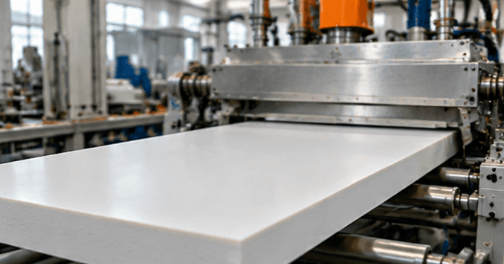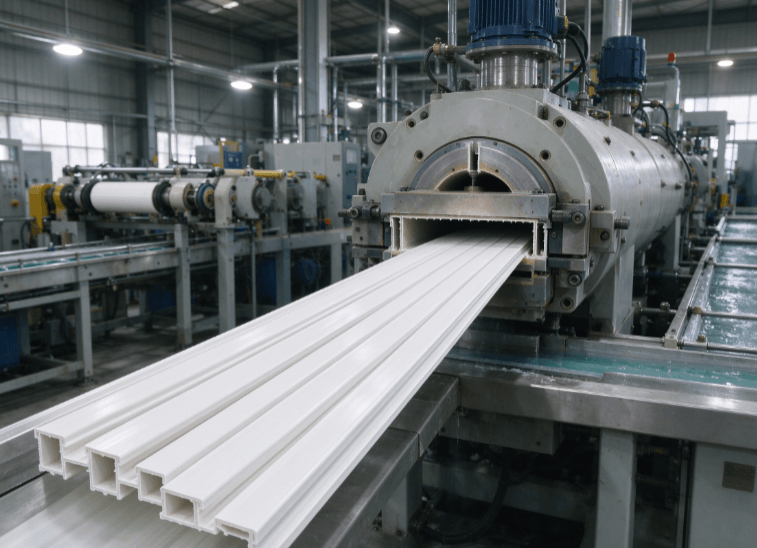


Understanding how to balance lightweight properties with structural integrity is the primary challenge in PVC foam board manufacturing. Whether you are producing advertising signage, construction templates, or high-end furniture boards, the core objective remains the same: achieving a uniform cellular structure that maximizes performance without unnecessary material waste.
Increasing pvc foam board density is not merely about adding more raw material; it is a sophisticated chemical balancing act involving melt strength, gas distribution, and thermal management. As manufacturers, we recognize that density directly dictates screw-holding power, impact resistance, and surface hardness.
Why Melt Strength is the Foundation of Density Control?
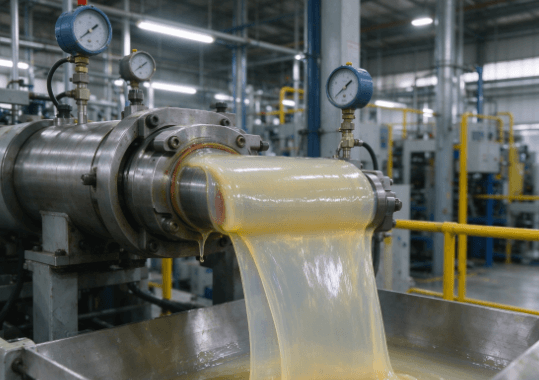
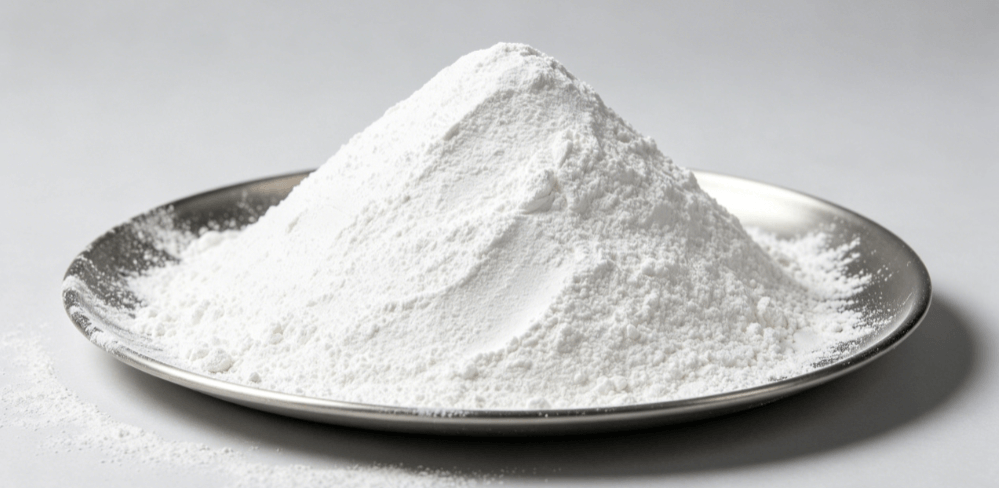
The density of a PVC foam board is primarily determined by how well the polymer melt can “hold” the gas bubbles generated by the blowing agent. If the melt strength is too low, the cells will rupture or coalesce, leading to large, uneven voids and a brittle board.
To achieve higher density and strength, we focus on enhancing melt elasticity. At MKQ Chem, our specialized foaming regulators—high-molecular-weight acrylic processing aids—are engineered to create a molecular “web.” This web increases the viscosity of the PVC melt, ensuring that as the gas expands, the cell walls remain intact and uniform. Without this elasticity, the gas escapes, the density becomes inconsistent, and the structural strength of the board fails to meet industrial standards like ASTM D792.
How Chemical Additives Influence Density and Mechanical Properties?
Chemical precision is the most effective lever for adjusting board characteristics. By fine-tuning the synergy between foaming agents and regulators, we can target specific density ranges for different applications.
- Foaming Regulators (ACR): These are critical for increasing the “stretchability” of the PVC melt. A higher dosage of regulator typically allows for a more controlled cell structure, which directly translates to higher surface hardness.
- Blowing Agents (AC/NC): The ratio between exothermic (AC) and endothermic (NC) agents determines the heat profile during gas release. Proper balance prevents over-foaming, which would otherwise decrease density and weaken the internal matrix.
- Lubrication Systems: Internal lubricants reduce friction between PVC molecules, while external lubricants prevent the melt from sticking to the metal surfaces of the extruder. Over-lubrication can cause “slippage,” leading to poor cell formation and reduced strength.
| Property | Low Density Board (0.4 – 0.5 g/cm³) | High Density Board (0.6 – 0.8 g/cm³) | Impact on Strength |
| Cell Structure | Large, airy cells | Micro-cellular, dense | Smaller cells increase load bearing |
| Screw Retention | Low; prone to stripping | High; excellent for furniture | Essential for assembly |
| Surface Hardness | Soft; easily dented | Hard; scratch-resistant | Crucial for construction |
| Tensile Strength | Moderate | High | Improves durability |
The Impact of Cooling and Calibration on Final Strength
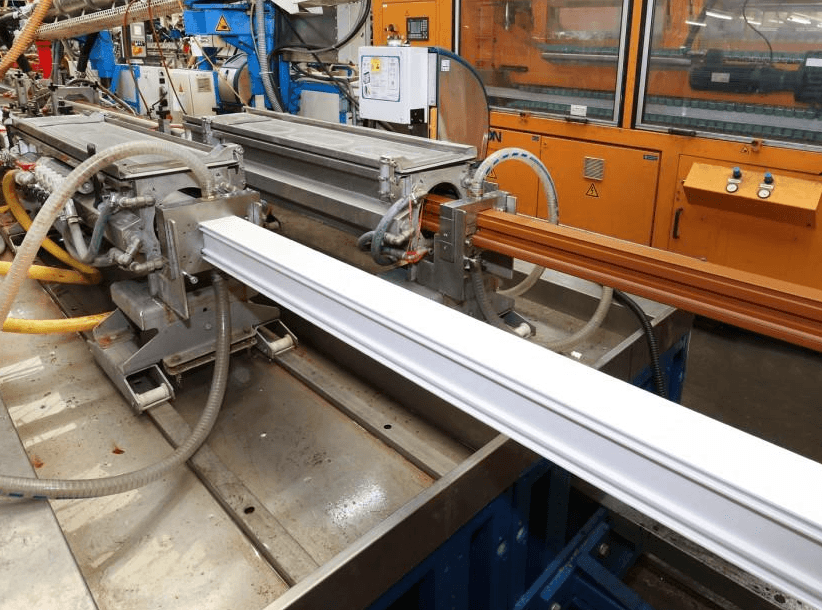
The transition from the extruder die to the cooling calibrator is where the final density of the PVC foam board is “set.” If the cooling is too slow, the core of the board remains hot, allowing bubbles to continue expanding, which lowers the density.
To increase density and strength, we implement rapid, controlled cooling. By chilling the surface of the board quickly, we create a “skin” effect. This dense outer layer provides the majority of the board’s flexural strength. In our manufacturing support programs, we often advise clients to optimize their vacuum calibration pressure. High vacuum levels pull the melt against the calibrator walls, ensuring a smooth, high-density surface while maintaining the desired thickness tolerances.
Selecting the Right Density for Industrial Applications
Higher density is not always “better,” but it is necessary for specific structural requirements. Identifying the right target density ensures cost-efficiency while meeting performance benchmarks.
- Construction & Building: Requires a density of 0.55 to 0.70 g/cm³. These boards must withstand impact and hold heavy fasteners.
- Cabinetry & Furniture: Often utilizes densities above 0.60 g/cm³ to ensure the edges can be routed and finished without exposing large voids.
- Advertising & Displays: Can operate at lower densities (0.40 – 0.50 g/cm³) where weight is a greater concern than structural load.
If you are looking to upgrade your product line, our team provides technical consultations on our product solutions to help you select the exact foaming regulators and processing aids required to hit these specific density targets.

Strategic Manufacturing Adjustments for Strength Enhancement
Beyond chemical additives, the mechanical settings of the twin-screw extruder play a vital role in board quality. To increase the strength of the PVC matrix, the shear heat must be managed precisely. Excessive shear can degrade the PVC polymer chains, resulting in a “burnt” core or brittle structure.
We recommend a graduated temperature profile that ensures the blowing agent decomposes at the precise moment the melt reaches the die. This ensures that the gas is evenly distributed, creating a micro-cellular structure. A micro-cellular structure (cells smaller than 100 microns) is the “gold standard” for high-strength PVC foam boards, as it minimizes the stress concentration points that lead to cracking.
FAQ
Q: Does increasing the density of the PVC foam board always increase the cost?
A: Generally, yes, because higher density requires more raw PVC resin and a higher dosage of foaming regulators. However, the increased strength often allows for thinner boards to be used in applications where a thicker, low-density board would have previously been required, potentially offsetting the cost.
Q: How do I fix a board that has a high density but is still brittle?
A: Brittleness usually stems from poor gelation or over-foaming. You may need to increase your ACR (foaming regulator) dosage to improve melt strength or adjust your lubrication system to ensure the PVC is properly fused before it exits the die.
Q: What is the ideal density for outdoor PVC signage?
A: For outdoor use, a density of 0.50 to 0.60 g/cm³ is typically recommended. This provides enough strength to resist wind loads and thermal expansion while remaining light enough for easy installation.
Q: Can I increase density by simply turning down the blowing agent?
A: While reducing the blowing agent will increase density, it can also lead to an uneven surface and internal stresses if the melt isn’t properly regulated. It is better to balance the blowing agent with a high-quality regulator to ensure the cells remain small and uniform.
Q: How does calcium carbonate (CaCO3) loading affect density and strength?
A: Adding CaCO3 increases the density because it is heavier than PVC, but it typically decreases the impact strength and makes the board more brittle if the loading exceeds 15-20%.
Reference Sources
ASTM International – Standard Test Method for Density of Plastics (D792)
https://www.astm.org/d0792-20.html
Vinyl Institute – Technical Resources for PVC Manufacturing
https://www.vinylinfo.org/resources/technical-resources/
British Plastics Federation – PVC Foams and Applications
https://www.bpf.co.uk/plastipedia/polymers/PVC.aspx