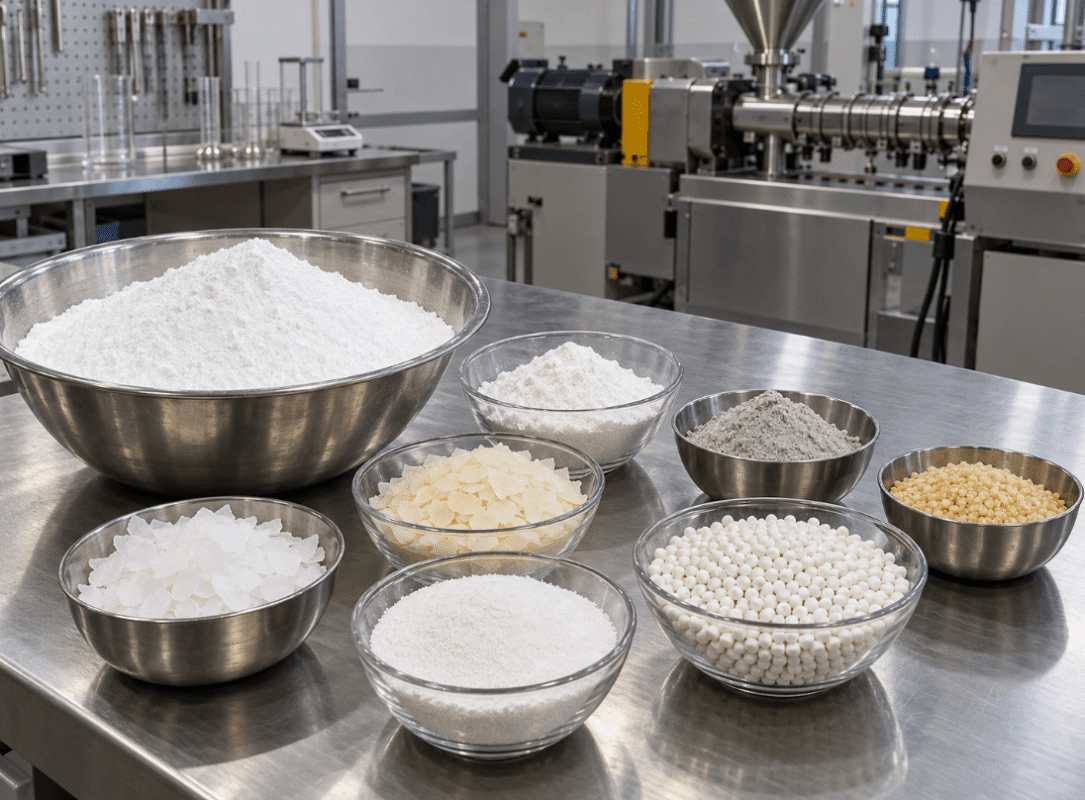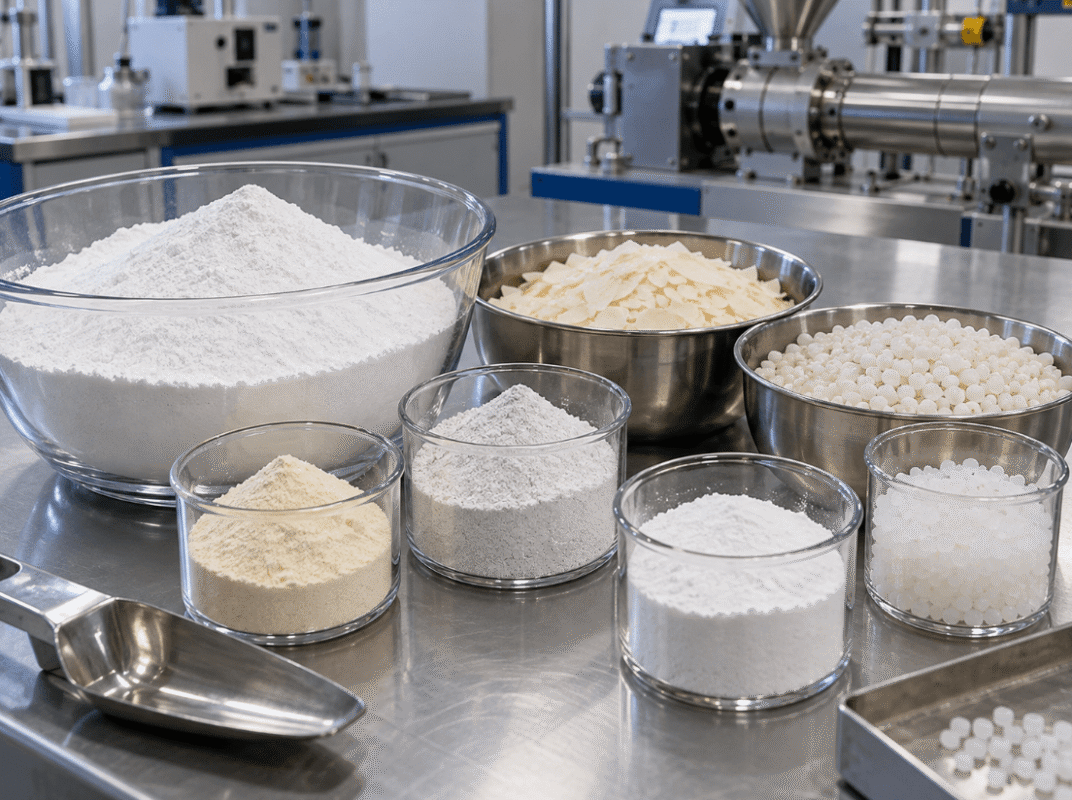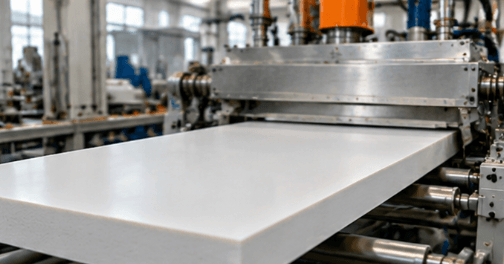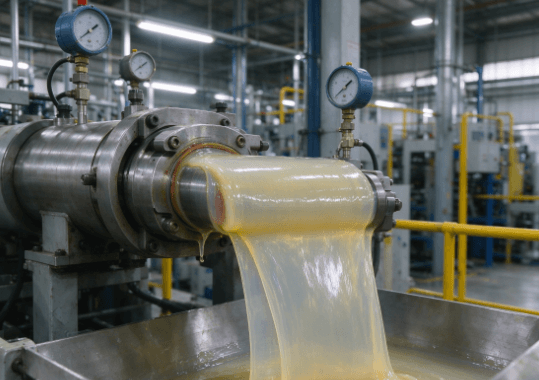

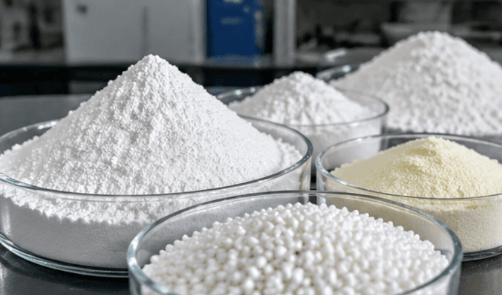
PVC foam board foaming agent dosage directly affects expansion, finished-board density, cell structure, and surface quality. The correct dosage depends on the foaming agent grade, PVC resin characteristics, filler loading, melt strength, processing temperature, and extrusion conditions. Manufacturers should use the supplier’s grade-specific recommendation as a starting point, then validate dosage through controlled production trials rather than relying on a universal percentage.
For PVC foam board manufacturers, the objective is not simply to achieve the lowest possible density. It is to produce boards that meet the required weight, thickness, surface finish, dimensional stability, and mechanical performance with consistent production results.
How Does Foaming Agent Dosage Affect PVC Foam Board Density?
Chemical foaming agents release gas during processing, creating cells within the PVC melt. When the melt retains these cells as the material expands, the finished board can achieve a lower apparent density. Increasing foaming agent dosage may increase expansion, but the result depends on gas yield, decomposition timing, melt strength, and the ability of the process to retain the generated gas.
Excessive dosage does not necessarily produce a better or lighter board. It may instead cause oversized cells, cell coalescence, surface pinholes, dimensional instability, or gas loss. The correct dosage is therefore the amount that achieves the target density while maintaining acceptable cell structure and finished-product quality.
Understanding Dosage in PHR
Foaming agent dosage is commonly expressed in phr, meaning parts by weight per 100 parts of PVC resin. For example, 1.0 phr represents 1 kg of foaming agent for every 100 kg of PVC resin. It does not mean 1% of the complete compound, which may also contain calcium carbonate, stabilizers, lubricants, processing aids, pigments, and other additives.
Using phr consistently helps manufacturers compare formulations and communicate technical requirements to additive suppliers.
What Is the Recommended PVC Foam Board Foaming Agent Dosage?
There is no single dosage suitable for every PVC foam board. The appropriate range depends on the chemical system, board type, target density, extrusion process, and complete formulation. The following figures are product-specific starting references published by MKQ Chemical, not universal formulation requirements.
| Foaming Agent | Application | Published Recommended Dosage |
|---|---|---|
| AC-1600 / AC-2000 | High-expansion advertising foam board / Forex board | 1.0–1.8 phr |
| AC-1600 / AC-2000 | Free-foam boards / decorative panels | 0.8–1.5 phr |
| NC-130 / NC-150 | Low-foam advertising boards / Celuka boards | 0.6–1.2 phr |
| NC-130 / NC-150 | PVC/WPC foam door panels, wall panels, and skirting | 0.8–1.5 phr |
These ranges refer to different product grades and applications. They should not be treated as interchangeable recipes. Confirm the current technical data sheet, recommended processing window, and compatibility with the intended formulation before selecting a starting dosage.
Manufacturers can compare grades in the PVC foaming agent product category and review the specific properties of the NC-150 medium-temperature endothermic foaming agent before arranging a formulation trial.
Six Factors That Affect PVC Foam Board Density
1. Foaming Agent Chemistry and Gas Yield
Different foaming agents have different decomposition temperatures, gas yields, and release characteristics. These properties determine how much gas is available and when it becomes available during extrusion.
For example, AC-based exothermic systems and NC-based endothermic systems have different thermal characteristics. Their suitability depends on the processing window, desired expansion, board structure, and formulation.
When comparing products, evaluate decomposition temperature, gas yield, particle size, dispersion, and compatibility with the stabilizer and lubrication systems. A higher gas yield alone does not guarantee a lower finished-board density because some gas may escape or fail to create stable cells.
2. PVC Resin Characteristics and Melt Strength
PVC resin grade affects fusion behavior, melt viscosity, and the ability of the compound to retain expanding gas. A formulation developed for one resin grade may not produce the same density or cell structure after a resin change.
Melt strength is particularly important in foam extrusion. The material must remain sufficiently cohesive as gas bubbles grow. If the melt cannot retain the cells, bubbles may merge, rupture, or collapse, producing uneven density and weak areas.
A processing aid or foaming regulator can help modify melt behavior, but its role differs from that of the chemical foaming agent. The foaming agent generates gas; the processing aid or regulator helps the melt maintain a suitable structure during expansion.
For this reason, manufacturers should assess the PVC processing aid for foam board as part of the overall formulation rather than attempting to solve every density problem by increasing foaming agent dosage.
3. Calcium Carbonate and Filler Loading
Calcium carbonate is commonly used in PVC foam board formulations to adjust stiffness, material cost, and processing characteristics. However, changing filler loading affects both compound mass and the rheological behavior of the material.
Increasing filler content does not automatically produce a predictable increase or decrease in foam density. The result depends on the filler characteristics, dispersion, formulation balance, and degree of expansion achieved during extrusion.
When filler loading changes, reassess the formulation instead of transferring the previous foaming agent dosage without testing. Record filler content consistently during comparative trials so that the effects of each adjustment can be interpreted.
4. Processing Temperature and Gas Release Timing
The decomposition behavior of the foaming agent must match the thermal history of the PVC compound. If gas is released too early, it may escape before the melt can retain it. If decomposition is incomplete or poorly timed, the board may not achieve the intended expansion.
Excessive thermal exposure can also contribute to PVC degradation and discoloration. Manufacturers should monitor the extrusion temperature profile, actual melt temperature where available, screw speed, output, and other relevant operating conditions.
Temperature settings should not be changed simultaneously with dosage during an initial comparison unless the trial is specifically designed to evaluate both variables. Otherwise, it becomes difficult to identify the cause of a density change.
5. Internal and External Lubrication
Lubricants influence friction, PVC fusion, melt flow, and release from metal surfaces. An unsuitable lubrication balance can interfere with the conditions required for consistent expansion.
Excessive external lubrication may delay fusion, while insufficient lubrication can increase friction and destabilize processing. Either condition may affect cell development, surface appearance, and dimensional consistency.
Before increasing the foaming agent dosage, verify that the lubrication system and fusion conditions are appropriate for the intended production process.
6. Extrusion Equipment and Cooling Conditions
Screw configuration, shear, residence time, die design, calibration, and cooling all influence the final board structure. Two production lines using the same formulation may produce different density and surface results because their thermal and mechanical conditions differ.
During extrusion trials, manufacturers should record relevant equipment settings and evaluate board thickness, cross-sectional cell structure, surface appearance, and dimensional stability. A dosage that works on one line should not be assumed to transfer directly to another line without validation.
How to Optimize Foaming Agent Dosage Without Sacrificing Quality
Step 1: Define the Product Requirements
Establish the target density, board thickness, surface finish, cell structure, dimensional tolerances, and relevant mechanical requirements. Free-foam and Celuka boards may require different expansion behavior and surface characteristics.
Step 2: Establish the Current Formulation
Record the PVC resin grade, filler loading, foaming agent grade and dosage, stabilizers, lubricants, processing aids, and other relevant additives. Also record extrusion settings and current finished-board measurements.
Step 3: Confirm the Supplier’s Recommended Range
Review the technical data sheet for the selected grade and obtain application-specific recommendations. Confirm the relevant processing window and any requirements for activators or other additives.
Step 4: Conduct Controlled Dosage Trials
Change dosage in controlled increments within the recommended range while keeping other variables as consistent as practical. Record each adjustment and the corresponding processing response.
Step 5: Measure Density and Inspect the Board
Use a consistent method to measure finished-board density. Inspect the cross-section for oversized cells, uneven expansion, voids, and collapsed regions. Also evaluate surface quality, thickness, dimensions, and relevant mechanical properties.
Step 6: Confirm Repeatability
Repeat the selected formulation under representative production conditions. Confirm that the board consistently meets the agreed specifications before approving the dosage for routine production.
For a broader understanding of how material preparation, extrusion, calibration, and cooling interact, see the PVC foam board manufacturing process guide.
Common Density Problems and Their Possible Causes
| Observed Problem | Possible Cause | Recommended Check |
|---|---|---|
| Density remains too high | Insufficient effective expansion, early gas loss, or poor cell retention | Review grade selection, dosage, gas release timing, and melt strength |
| Large or irregular cells | Cell coalescence or unstable melt behavior | Review processing aid, extrusion conditions, and gas-release timing |
| Uneven board thickness | Unstable expansion, output variation, or calibration problems | Check extrusion output, die conditions, and cooling |
| Surface pinholes or roughness | Unstable foaming, surface-cell rupture, or tooling issues | Inspect the die, formulation balance, and dosage |
| Yellowing or discoloration | Excessive thermal exposure or inadequate stabilization | Review melt temperature, residence time, and stabilizer system |
These symptoms can have multiple causes. Increasing the foaming agent dosage without identifying the underlying problem may increase scrap and production costs rather than improve board quality.

What Should Buyers Verify Before Purchasing a PVC Foaming Agent?
Commercial buyers should evaluate the suitability of the product for their actual formulation instead of relying only on a generic product description.
- Application suitability: Confirm whether the grade is intended for free-foam boards, Celuka boards, or another PVC application.
- Technical documentation: Request the current technical data sheet and safety data sheet.
- Dosage guidance: Verify the recommended range and whether it is expressed per 100 parts of PVC resin.
- Quality consistency: Ask about batch specifications and available certificates of analysis.
- Sample validation: Agree on the test conditions and acceptance criteria before evaluating a sample.
- Commercial terms: Confirm packaging, minimum order quantity, lead time, and export documentation.
When contacting a supplier, provide the target density, board type, thickness, resin grade, filler loading, current foaming agent, and extrusion conditions. This information makes it easier to assess whether a candidate grade is suitable for a production trial.
Conclusion
PVC foam board foaming agent dosage affects expansion, density, cell structure, and surface quality, but the final result depends on the entire formulation and extrusion process. Foaming agent chemistry, resin characteristics, filler loading, melt strength, lubrication, temperature, and cooling must be considered together.
The most reliable approach is to begin with a grade-specific supplier recommendation, run controlled dosage trials, and verify finished-board quality under representative production conditions. This helps manufacturers select an appropriate foaming agent without relying on unsupported universal dosage figures.
Frequently Asked Questions
What is the typical foaming agent dosage for PVC foam boards?
There is no universal dosage for all PVC foam boards. The appropriate amount depends on the foaming agent grade, board type, target density, formulation, and processing conditions. Use the supplier’s grade-specific recommendation as a starting point and validate it through controlled trials.
Does increasing foaming agent dosage always reduce PVC foam board density?
No. Increasing dosage may improve expansion when gas generation and melt strength are properly balanced. Excessive dosage can instead cause gas loss, oversized cells, surface defects, or unstable dimensions.
How does calcium carbonate affect PVC foam board density?
Calcium carbonate changes compound mass and rheology, which can affect expansion and cell development. Its overall effect depends on filler loading, dispersion, and the degree of expansion achieved during extrusion.
What is the difference between a foaming agent and a foaming regulator?
A foaming agent generates gas to create the cellular structure. A foaming regulator or suitable processing aid modifies melt behavior and helps the material retain a stable foam structure. They perform different functions and may be used together.
How can manufacturers confirm the correct foaming agent dosage?
Run controlled dosage trials, measure finished-board density consistently, inspect cell structure, and assess surface quality, dimensions, and relevant mechanical properties. Confirm repeatability under normal production conditions before approving the formulation.